New Gas Attack in Syria Is False Flag Yet Again
Exclusive: The U.S. government and the mainstream media rushed to judgment again, blaming the Syrian regime for a new poisonous substance-gas attack and ignoring other possibilities, reports Robert Parry.
By Robert Parry
With the latest hasty judgment well-nigh Tuesday's poison-gas deaths in a insubordinate-held area of northern Syria, the mainstream U.S. news media again reveals itself to exist a threat to responsible journalism and to the future of humanity. Once more, we encounter the troubling pattern of verdict kickoff, investigation later, even when that behavior can pb to a unsafe state of war escalation and many more deaths.
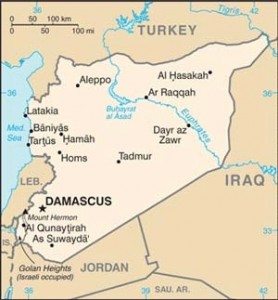
Map of Syria.
Earlier a careful evaluation of the show almost Tuesday'south tragedy was possible, The New York Times and other major U.S. news outlets had pinned the blame for the scores of dead on the Syrian regime of Bashar al-Assad. That revived demands that the U.South. and other nations establish a "no-fly zone" over Syria, which would amount to launching another "regime change" state of war and would put America into a likely hot war with nuclear-armed Russian federation.
Fifty-fifty as basic facts were still being assembled well-nigh Tuesday's incident, we, the public, were prepped to disbelieve the Syrian government's response that the poison gas may have come from rebel stockpiles that could have been released either accidentally or intentionally causing the civilian deaths in a town in Idlib Province.
One possible scenario was that Syrian warplanes bombed a rebel weapons depot where the toxicant gas was stored, causing the containers to rupture. Some other possibility was a staged outcome past increasingly desperate Al Qaeda jihadists who are known for their disregard for innocent human life.
While it's hard to know at this early on phase what's true and what's not, these alternative explanations, I'thousand told, are being seriously examined by U.S. intelligence. One source cited the possibility that Turkey had supplied the rebels with the poison gas (the verbal type all the same not adamant) for potential use against Kurdish forces operating in northern Syria near the Turkish border or for a terror set on in a government-controlled city similar the capital of Damascus.
Reporting by investigative journalist Seymour Hersh and statements past some Turkish police and opposition politicians linked Turkish intelligence and Al Qaeda-affiliated jihadists to the Aug. 21, 2013 sarin gas attack outside Damascus that killed hundreds, although the Times and other major U.S. news outlets continue to blame that incident on Assad's regime.
Seasoned Propagandists
On Tuesday, the Times assigned two of its most committed anti-Syrian-regime propagandists to cover the Syrian poisonous substance-gas story, Michael R. Gordon and Anne Barnard.
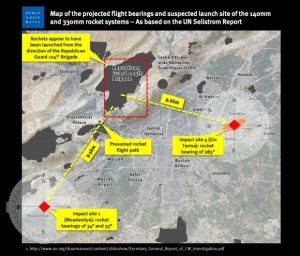
The controversial map developed past Human Rights Watch and embraced by the New York Times, supposedly showing the flight paths of two missiles from the Aug. 21 Sarin assault intersecting at a Syrian military base.
Gordon has been at the forepart lines of the neocon "regime change" strategies for years. He co-authored the Times' infamous aluminum tube story of Sept. 8, 2002, which relied on U.Due south. government sources and Iraqi defectors to affright Americans with images of "mushroom clouds" if they didn't support President George W. Bush'southward upcoming invasion of Iraq. The timing played perfectly into the assistants's advertizement "rollout" for the Republic of iraq State of war.
Of form, the story turned out to exist false and to have unfairly downplayed skeptics of the claim that the aluminum tubes were for nuclear centrifuges, when the aluminum tubes actually were meant for artillery. Merely the article provided a great impetus toward the Iraq State of war, which concluded up killing nearly four,500 U.Due south. soldiers and hundreds of thousands of Iraqis.
Gordon's co-author, Judith Miller, became the only U.S. announcer known to take lost a chore over the reckless and shoddy reporting that contributed to the Republic of iraq disaster. For his part, Gordon connected serving every bit a respected Pentagon contributor.
Gordon's name besides showed up in a supporting role on the Times' botched "vector analysis," which supposedly proved that the Syrian armed services was responsible for the Aug. 21, 2013 sarin-gas set on. The "vector analysis" story of Sept. 17, 2013, traced the flight paths of two rockets, recovered in suburbs of Damascus dorsum to a Syrian armed forces base 9.5 kilometers abroad.
The commodity became the "slam-dunk" evidence that the Syrian government was lying when it denied launching the sarin attack. Yet, similar the aluminum tube story, the Times' "vector analysis" ignored contrary evidence, such as the unreliability of one azimuth from a rocket that landed in Moadamiya because it had struck a building in its descent. That rocket likewise was found to contain no sarin, and so information technology'southward inclusion in the vectoring of ii sarin-laden rockets fabricated no sense.
Only the Times' story ultimately barbarous autonomously when rocket scientists analyzed the 1 sarin-laden rocket that had landed in the Zamalka area and determined that information technology had a maximum range of about ii kilometers, meaning that it could not have originated from the Syrian military base. C.J. Chivers, i of the co-authors of the article, waited until Dec. 28, 2013, to publish a halfhearted semi-retraction. [See Consortiumnews.com'due south "NYT Backs Off Its Syria-Sarin Analysis."]
Gordon was a co-writer of another artificial Times' front-page story on Apr 21, 2014, when the State Department and the Ukrainian authorities fed the Times two photographs that supposedly proved that a group of Russian soldiers – outset photographed in Russia – had entered Ukraine, where they were photographed again.
However, ii days subsequently, Gordon was forced to pen a retraction because it turned out that both photos had been shot inside Ukraine, destroying the story's premise. [See Consortiumnews.com's "NYT Retracts Russian-Photograph Scoop."]
Gordon perhaps personifies better than anyone how mainstream journalism works. If you lot publish imitation stories that fit with the Establishment's narratives, your chore is safe even if the stories accident up in your face. Nevertheless, if yous go against the grain – and if someone of import raises a question about your story – y'all can easily notice yourself out on the street even if your story is correct.
No Skepticism Immune
Anne Barnard, Gordon's co-writer on Tuesday'due south Syrian poison-gas story, has consistently reported on the Syrian conflict every bit if she were a printing agent for the rebels, playing up their anti-regime claims fifty-fifty when there's no prove.

A centre-rending propaganda image designed to justify a major U.Southward. military machine operation inside Syria against the Syrian military.
For instance, on June 2, 2015, Barnard, who is based in Beirut, Lebanon, authored a forepart-page story that pushed the rebels' propaganda theme that the Syrian government was somehow in cahoots with the Islamic Land though fifty-fifty the U.S. State Section acknowledged that it had no confirmation of the rebels' claims.
When Gordon and Barnard teamed up to report on the latest Syrian tragedy, they again showed no skepticism about early U.Due south. regime and Syrian insubordinate claims that the Syrian war machine was responsible for intentionally deploying poison gas.
Perchance for the first time, The New York Times cited President Trump every bit a reliable source because he and his printing secretarial assistant were saying what the Times wanted to hear – that Assad must be guilty.
Gordon and Barnard also cited the controversial White Helmets, the rebels' Western-financed civil defense group that has worked in close proximity with Al Qaeda'south Nusra Front and has come under suspicion of staging heroic "rescues" just is nevertheless treated as a fount of truth-telling by the mainstream U.South. news media.
In early on online versions of the Times' story, a reaction from the Syrian military was buried deep in the article around the 27th paragraph, noting: "The regime denies that information technology has used chemic weapons, arguing that insurgents and Islamic State fighters use toxins to frame the government or that the attacks are staged."
The post-obit paragraph mentioned the possibility that a Syrian bombing raid had struck a insubordinate warehouse where poison-gas was stored, thus releasing it unintentionally.
But the placement of the response was a clear message that the Times disbelieved whatever the Assad authorities said. At least in the version of the story that appeared in the morning newspaper, a government statement was moved upward to the sixth paragraph although notwithstanding surrounded by comments meant to signal the Times' credence of the insubordinate version.
Afterward noting the Assad regime's deprival, Gordon and Barnard added, "But merely the Syrian armed services had the ability and the motive to carry out an aerial attack like the 1 that struck the insubordinate-held boondocks of Khan Sheikhoun."
Simply they again ignored the culling possibilities. One was that a bombing raid ruptured containers for chemicals that the rebels were planning to use in some future set on, and the other was that Al Qaeda's jihadists staged the incident to elicit precisely the international outrage directed at Assad every bit has occurred.
Gordon and Barnard also could be wrong about Assad being the simply one with a motive to deploy poison gas. Since Assad's forces have gained a decisive upper-hand over the rebels, why would he chance stirring up international outrage at this juncture? On the other hand, the desperate rebels might view the horrific scenes from the chemical-weapons deployment every bit a last-minute game-changer.
Pressure to Prejudge
None of this ways that Assad's forces are innocent, but a serious investigation ascertains the facts then reaches a decision, not the other way effectually.
Syrian President Bashar al-Assad.
However, to advise these other possibilities will, I suppose, draw the usual accusations almost "Assad apologist," but refusing to prejudge an investigation is what journalism is supposed to be nearly.
The Times, however, apparently has no business organization anymore for letting the facts be assembled and so letting them speak for themselves. The Times weighed in on Midweek with an editorial entitled "A New Level of Depravity From Mr. Assad."
Another trouble with the behavior of the Times and the mainstream media is that by jumping to a conclusion they pressure other important people to join in the condemnations and that, in plow, tin can prejudice the investigation while also generating a dangerous momentum toward state of war.
One time the political leadership pronounces judgment, it becomes career-threatening for lower-level officials to disagree with those conclusions. Nosotros've seen that already with how United Nations investigators accepted rebel claims about the Syrian government's use of chlorine gas, a set of accusations that the Times and other media at present study but every bit apartment-fact.
All the same, the claims about the Syrian military mixing in canisters of chlorine in supposed "barrel bombs" make little sense because chlorine deployed in that fashion is ineffective equally a lethal weapon but it has become an important element of the rebels' propaganda campaign.
U.Northward. investigators, who were under intense pressure from the The states and Western nations to give them something to utilize confronting Assad, did back up rebel claims about the government using chlorine in a couple of cases, simply the investigators also received testimony from residents in i area who described the staging of a chlorine attack for propaganda purposes.
One might have thought that the prove of one staged assault would have increased skepticism about the other incidents, but the U.N. investigators plainly understood what was skillful for their careers, then they endorsed a couple of other declared cases despite their disability to conduct a field investigation. [See Consortiumnews.com'southward "United nations Team Heard Claims of Staged Chemical Attacks."]
Now, that dubious U.Due north. report is being leveraged into this new incident, ane opportunistic finding used to justify another. But the pressing question now is: Have the American people come to understand enough about "psychological operations" and "strategic communications" that they will finally show the skepticism that no longer exists in the major U.S. news media?
Investigative reporter Robert Parry broke many of the Iran-Contra stories for The Associated Printing and Newsweek in the 1980s. You can buy his latest volume, America's Stolen Narrative, either in impress here or equally an e-book (from Amazon and barnesandnoble.com).
Source: https://consortiumnews.com/2017/04/05/another-dangerous-rush-to-judgment-in-syria/
0 Response to "New Gas Attack in Syria Is False Flag Yet Again"
Post a Comment